


Today we'll show you how to create a marble print, which gives a very special look and is very popular in the polymer clay world. We'll take you step by step through the process. In the next 6 steps, you'll learn how to make your own marble earrings—how fun is that!

Interested? Then read on and create your own marble earrings!
Step 1
Make sure you have the following supplies at home.
Supplies;
- Correct surface; for example, an acrylic sheet, glass sheet, tile or polished marble slab
- Gloves
- Pasta machine or depth guide tools
- Acrylic roller
- Tissue blade
- Acrylic paint
- A small bowl of cornstarch
- Cutters
- A fluffy brush
- Polymer clay in desired colors (or a nice color recipe )
- Fimo liquid
- Clay tools set (the smallest dotting tool)
- Oven with optional separate thermometer
- Baking paper
- Sandpaper grit 320, 600, 1200
- Bowl of water
- Varnish (polymer clay lacquer) and a brush
- Hand drill or a dremel
- Jump rings
- Earposts (balls)
- 2 pliers

Step 2
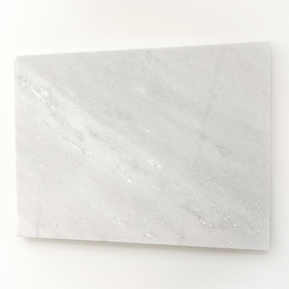
We start with the right surface. In the previous blog post, you already read how important the right surface is. So, choose an acrylic sheet, glass sheet, tile, or polished marble slab. This ensures the clay stays in place.
Gloves are essential for this process—it's going to be messy! First, we'll condition the clay, so we'll make sure it's been rolled out thoroughly several times and warmed up a bit by using our hands. This ensures the clay bonds well and prevents cracks and weak spots. Save a small amount of clay; you can optionally use it for the back of the marble print. We'll come back to this later.
Then, using your sharp tissue paper blade, cut small pieces. You can use multiple colors, depending on your preference. If you keep the pieces a bit larger and coarser, your marble print will be similar. If you keep the pieces very small, the more refined the print will be. So you can really play with the effect you want. Once all the pieces are cut, place them on a piece of baking paper. Spread them out on this and let's start with the messy part!

Drop small dots of acrylic paint onto the clay, but don't apply too much, as it will dry very slowly. All the pieces should be covered with an equal amount of paint. So, you should only be able to see the color of the paint, not the clay itself. Letting it dry is an important step. You can speed it up a bit with a hairdryer or fan. Make sure it's completely dry, otherwise you won't get the desired effect.


Step 3
Once all the dipped pieces are completely dry, we can move on to the next step: fusing them together into a nice block or roll. Change your gloves for clean ones and pour a small amount of liquid Fimo clay over the pieces. A little is enough. Gather all the pieces and shape them into a block or roll (don't knead (!), but press the blocks firmly together). Be sure to spend some time on this. You want the clay to adhere well.


Now you've created a beautiful roll or block, and here comes the best part! The big reveal of your marble print. Cut slices with your tissue blade, trying to keep them even. But don't cut too thin, as you still need to be able to roll it to the desired thickness.


There are now 2 options you can apply;
Option 1 creates a marble print on both sides, while option 2 has a smooth back. If you're just starting out, option 2 is the best option. It provides a slightly firmer base.
Option 1
Place all the slices side by side and roll them out well so they're firmly attached. Then, use the depth guide or pasta machine to ensure everything is the same thickness. I personally prefer a thickness of 2.8 mm.

Option 2
Roll out a very thin layer of clay. Place the slices on top of it and roll it out again. Then, use the depth guide or pasta machine to ensure everything is the same thickness. I personally prefer a thickness of 2.8 mm.

Step 4
Now that you've rolled out your artwork and you can see the beautiful pattern, it's time to cut it out. Grab your bowl of cornstarch, cutters, and your tissue paper.
Dip your cutter in the bowl of cornstarch, cut out your shape well so that the cutter touches the surface properly. In our previous blog You can find an extensive description about this here.

Use your tissue paper to loosen the clay charm from the surface and wipe away any remaining cornstarch with your fluffy brush. The cut-out clay charm can now be placed on a clean sheet of baking paper. Repeat this process until all the clay charms are on the baking paper. With the smallest dotting tool, you can poke a small hole where you'll drill later. This will serve as a guideline for drilling. Make sure all the charms lie flat. And be careful not to get fingerprints on the clay. That would be a shame.


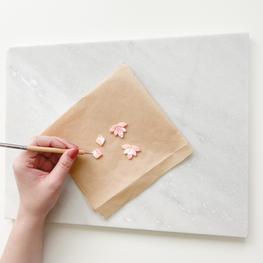
Now it's time to bake for 50 minutes at 110 degrees Celsius. You can use your thermometer to ensure it doesn't get too hot.
Once the clay comes out of the oven, it really needs to harden. I usually leave the clay charms alone for a day to let them harden properly. If you're in a hurry, you can also shock the charms in ice water.

Time to drill the holes, but since we've already made a guide with the smallest dotting tool, this should be a piece of cake. You can use a hand drill or a Dremel. I always use a 0.9 mm - 1.2 mm drill bit (depending on the thickness of the jump ring).
After this, lightly sand the 1200 grit sandpaper with a little water and give each clay charm a quick wash. Pat them dry thoroughly.


Once that's done, we can seal the clay charms. This is an important step with marbled prints, as the seal can otherwise wear off during use. A thin layer is sufficient, and don't forget the back and edges.

Step 6
Once all these steps are complete, it's time to assemble your jewelry. Open the jump rings slightly and then attach them through the hole in your clay charm. Once all the parts are attached, use your second pair of pliers to close everything up nicely. Also attach your ear post (ball) with a jump ring.


And after that? Right, it's time to put those beauties in your ears! And be incredibly proud that you just made them. Post your beautiful earrings on Instagram and don't forget to tag Sieradenstraatje in your post. I'm so curious to see your creation!
